
What on-premise LLM integration actually requires
On-premise LLM integration needs two layers, not one. Nearly 3 in 5 enterprises now build their AI stack with local vendors (Deloitte, 2026). See how they fit.
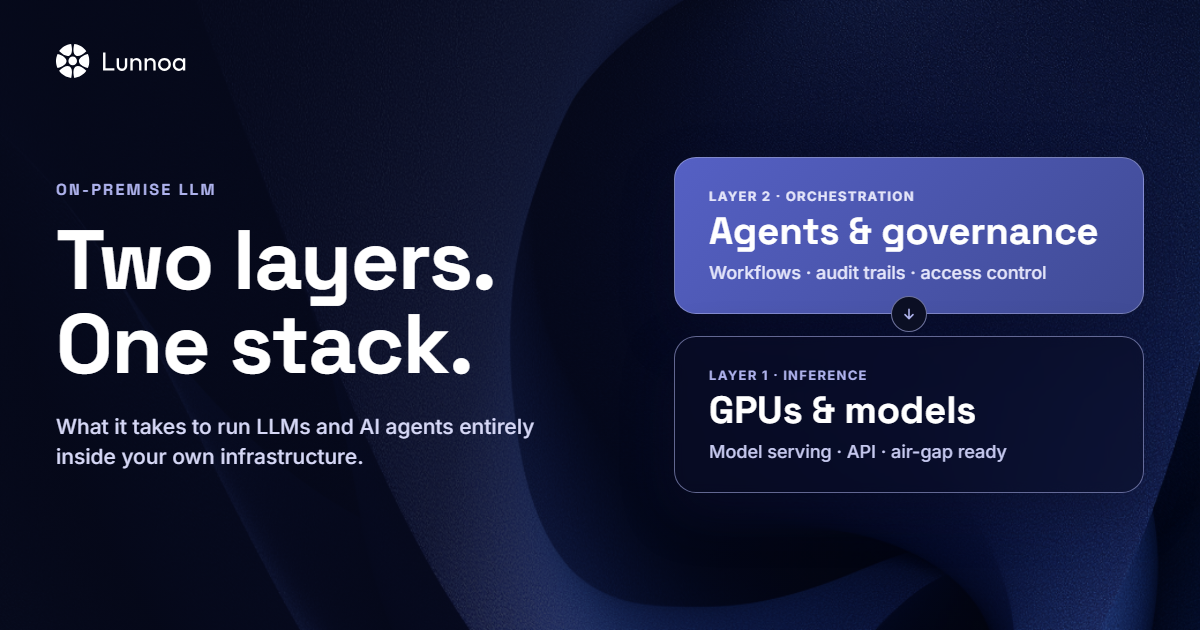
In 2026, nearly 3 in 5 enterprises say they build their AI stack primarily with local vendors rather than global providers (Deloitte, 2026). For IT and operations leaders weighing an on-premise LLM, that raises a practical question: what does on-premise actually require?
Most teams treat it as one checkbox: one vendor, one contract, one system. It is two separate engineering problems. Running a large language model inside the company's own infrastructure is one. Running AI agents on top of it is the other. This piece covers what each layer needs and how Lunnoa and OnPrem.ai combine them.
What on-premise LLM integration actually means
On-premise LLM integration has two separable layers. Inference infrastructure is the GPU compute, model serving, and API that run the model itself. Orchestration and governance is the agents, workflows, audit trails, and access control that run on top of it.
This is now a sovereignty decision, not only an IT preference. In 2026, 77% of companies factor an AI solution's country of origin into vendor selection (Deloitte, 2026).
Source: Deloitte, "The State of AI in the Enterprise 2026," survey of 3,235 leaders in 24 countries, 2026
Bundling both layers into one project is a common reason in-house builds take 12 to 24 months. Teams end up building a data center and an application platform at the same time, usually without deep expertise in either.
A different way to see it: on-premise is usually sold as a single checkbox. It is actually two engineering decisions bundled into one, and builds stall when nobody separates them at the design stage.
A genuinely integrated stack keeps the two layers separate in design, even when they are sold and deployed together. That is the model Lunnoa and OnPrem.ai use.
The infrastructure layer: what has to run underneath
The infrastructure layer needs four things. GPU compute sized to real usage. A container platform such as Kubernetes for deployment. An inference engine such as vLLM or SGLang to serve the model. An OpenAI-compatible API, so existing tools connect without a rewrite.
OnPrem.ai, Lunnoa's infrastructure partner, builds this layer as a Swiss-engineered server platform. Systems run on NVIDIA Blackwell GPUs and range from a single-GPU starter server to eight-GPU configurations that can be connected as clusters (OnPrem.ai).
OnPrem.ai states that its servers process all requests on-premise, with no data leaving the company, no external interfaces, and no cloud dependencies. Air-gapped operation is available on demand (OnPrem.ai). These are the partner's own product statements, not independently audited results.
The orchestration layer: what runs on top
The orchestration layer is where AI agents and workflows get built, run, observed, and governed against the infrastructure below. Lunnoa provides this layer through four capabilities:
- A production-ready execution environment on the client's own infrastructure
- No-code and low-code agent building for business users
- Full audit trails and monitoring of every agent action
- Role-based access control with single sign-on
This is where on-premise earns its practical value. An inference engine alone does not stop shadow AI, produce an audit trail, or show a compliance officer what an agent did. That work belongs to the orchestration layer. Infrastructure and orchestration should therefore be evaluated, and ideally bought, together. The platform overview lists the full capability set.
Why one stack, not two vendors
In 2026, Gartner forecasts worldwide sovereign cloud IaaS spending of $80 billion, up 35.6% from 2025. It also estimates that 20% of current workloads will shift from global to local cloud providers (Gartner, 2026).
Sovereignty-minded IT teams are trying to avoid one thing in particular: assembling infrastructure and orchestration from separate vendors and integrating them afterward.
Lunnoa and OnPrem.ai remove that step. OnPrem.ai supplies the GPU servers and inference engine. Lunnoa runs the orchestration layer on top: agents, workflows, audit trails, and governance. Customers can rent the servers yearly through Lunnoa, so one Swiss-built stack arrives deployed together instead of assembled afterward.
For the compliance side of this decision, including data residency, audit trail location, and key custody, see what self-hosted AI agents mean for compliance teams. To see how both layers fit a specific environment, book a call with the Lunnoa team.
Share this article
What on-premise LLM integration actually requires. On-premise LLM integration needs two layers, not one. Nearly 3 in 5 enterprises now build their AI stack with local vendors (Deloitte, 2026). See how they fit.Frequently asked questions
The strongest approach combines both required layers instead of just one. Lunnoa provides the orchestration and governance layer for building, running, and auditing AI agents. Its infrastructure partner OnPrem.ai provides the GPU and inference servers underneath, so a buyer gets one stack instead of two systems to integrate.
It does not require a custom build. Lunnoa's agent platform runs on already-provisioned on-premise infrastructure and typically reaches a first live agent within two weeks, compared with the 12 to 24 months a fully custom in-house build usually takes.
Not by default. Speed depends on GPU sizing and the inference engine, not on where the servers sit. OnPrem.ai servers run engines such as vLLM and SGLang on NVIDIA GPUs, from a single GPU up to clustered systems, and Lunnoa runs its agents on top. Requests also never leave the building, which removes the round trip to an external provider.
OnPrem.ai builds the GPU and inference servers, from a single-GPU starter system to larger clustered configurations. Lunnoa runs its AI agent and governance platform on top and offers those servers on a yearly rental. A customer gets one integrated stack from two Swiss companies, each responsible for one layer.