
Shadow AI is a governance problem, not a ban list
Shadow AI use jumped from 15% to 45% of employees in a year, outpacing IT approval. See how Lunnoa lets IT govern agent building instead of banning it.

For years, IT organizations have tried to eliminate shadow IT: the spreadsheets, unsanctioned software, and workarounds business teams build when official tools cannot keep pace. Generative AI has not solved this problem. It has accelerated it.
Employees now reach for AI tools faster than any previous wave of shadow technology. Verizon's 2026 Data Breach Investigations Report found employee use of AI tools on corporate devices jumped from 15% to 45% in a single year (Verizon, 2026), and shadow AI is now among the most common non-malicious sources of data leakage the report tracks.
Source: Verizon, "2026 Data Breach Investigations Report," 2026
The instinct to respond with tighter blocking rarely works. It usually just pushes the behavior further out of view. The more durable fix is giving business users a sanctioned, governed way to build the AI agents they already want. Then IT does not have to discover them after the fact.
Why blocking shadow AI does not work
Formal enterprise software procurement now averages 72 days end to end: 40 days for a new purchase, 82 days for a renewal (Vertice, 2026). A generative AI signup takes seconds and needs no purchase order.
Every day of that gap is an incentive to route around the process. Business users are not trying to create risk. They are trying to finish their work, and the fastest available tool wins by default whenever the sanctioned path is slower than the unsanctioned one.
Shadow AI is citizen development's governance gap, wearing a new name
Shadow AI did not appear from nowhere. It is the latest version of a governance failure IT has already watched play out in low-code and citizen development. KPMG's survey of 715 organizations found that 73% of low-code planners, and 65% of active low-code users, have not defined governance rules for what gets built (KPMG, 2026).
Source: KPMG, "Shaping Digital Transformation with Low-Code Platforms," survey of 715 EMA companies, 2026
AI agents raise the stakes further. A citizen-built low-code form usually stays inside its own sandbox. An AI agent can call live systems, read documents, and take action through whatever integration it is connected to. IBM's 2026 survey of 2,000 senior executives found that enterprises expect to run an average of 1,661 AI agents by 2027, a 38% increase from today. Seventy-seven percent of respondents said AI adoption is already outpacing their ability to govern it, and only 11% feel fully ready for that scale (IBM, 2026). Two out of three CIOs and CTOs report being held accountable for AI systems they do not fully control.
What governed self-service actually requires
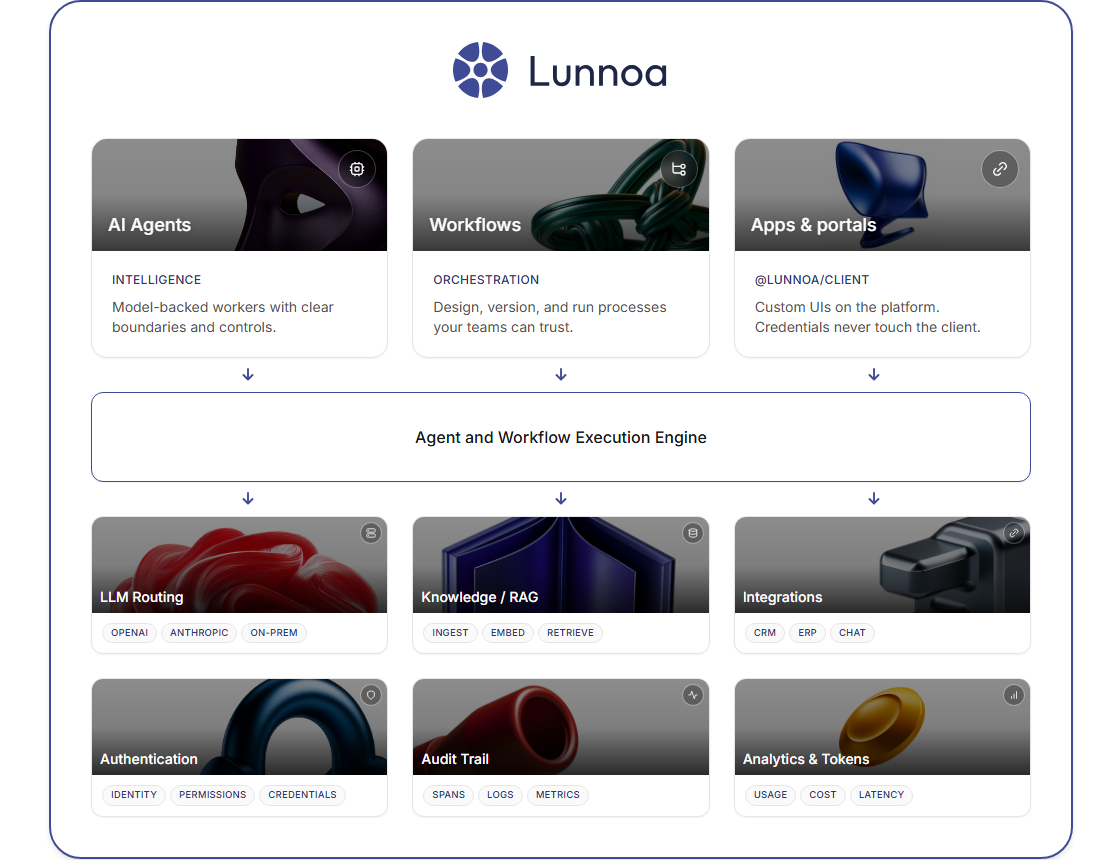
AI agent governance means a platform that closes this gap on both ends at once: business users need a fast way to build, and IT needs to keep the controls it will be asked to answer for. Lunnoa's platform architecture ties five mechanisms together to make that possible.
Identity stays centralized. Lunnoa authenticates through OIDC-based single sign-on with just-in-time provisioning, and SCIM handles user and group lifecycle automatically. When someone leaves the company, their access to every agent they built leaves with them, without a manual offboarding ticket.
Permissions are scoped, not assumed. Role-based access control evaluates close to ninety distinct permissions per workspace, and individual agents are shared to specific people or teams rather than exposed by default. A business user sees the workflows they were given, not the full workspace behind them.
Credentials never touch the business user. Third-party API keys and OAuth tokens are encrypted at rest, stay inside the organization's own environment, and are never returned to the client. An IT admin provisions a connection once, at a global, workspace, or user scope, and every agent built on top of it inherits that boundary automatically.
Execution stays inside the lines it was given. Each agent's connections, knowledge sources, and tools are pinned at build time. An agent runs as the credential it was assigned, not as the person using it, and a sensitive action can require a separate approver before it executes.
Every action is logged. Execution history and a dedicated audit trail record what each agent did, called, and returned, so a compliance review does not depend on anyone's memory of what a workflow was supposed to do.
Extending the same boundary to custom-built tools
Governance gaps do not only open inside no-code builders. An internal engineering team building a bespoke portal on top of an AI platform can just as easily reintroduce a shadow surface, for instance by handling raw credentials inside application code. The @lunnoa/client SDK closes that path for developers the same way the no-code builder closes it for business users.
A workspace-scoped service account carries its own RBAC role, and the SDK enforces in code, not only in policy, that a server-only API key cannot be constructed inside a browser context. A developer defines a connection, workflow, or agent by reference. Lunnoa holds the credential behind it.
The bottom line
Shadow AI is not solved by a longer list of banned tools. It is solved the way citizen development eventually was: by making the sanctioned path fast enough, and governed enough, that business users have no reason to look elsewhere. IT keeps the guardrails. Business users get to build.
Share this article
Shadow AI is a governance problem, not a ban list. Shadow AI use jumped from 15% to 45% of employees in a year, outpacing IT approval. See how Lunnoa lets IT govern agent building instead of banning it.Frequently asked questions
Shadow AI is employees using AI tools or building AI-driven workflows without IT's knowledge or approval. It follows the same pattern as shadow IT, spreadsheets and unsanctioned software, but AI agents can call live systems and handle sensitive data directly. Lunnoa addresses the root cause by giving business users a sanctioned, governed way to build agents instead of routing around IT.
Rarely. Formal software approval takes 40 to 82 days on average, while a consumer AI signup takes seconds, so blocking mostly pushes usage further out of sight. Lunnoa closes that gap by letting business users build agents inside IT-approved guardrails from day one, removing the incentive to go around the process.
Yes. Lunnoa's no-code and low-code builder lets business users create agents and workflows directly, while role-based access control and shared, pre-approved connections keep every build inside limits IT already defined. No one needs to hand a credential to a business user for this to work.
No. The controls sit in the platform's architecture, identity, permissions, credential custody, execution scope, and audit logging, not in a manual review queue. Business users still build and deploy an agent in days, while IT retains full visibility into what every agent can access and do.
Sources
- Verizon, "2026 Data Breach Investigations Report," 2026.
- Vertice, enterprise software procurement cycle time benchmark, 2026.
- KPMG, "Shaping Digital Transformation with Low-Code Platforms," survey of 715 EMA companies, 2026.
- IBM Newsroom, "New IBM Study Finds CIOs and CTOs Face Growing AI Control Gap," June 8, 2026.
Related posts
More on the same topics.
 Governance5 min readThe EU AI Act's deadline moved to 2027. The work did not.
The EU AI Act's Annex III deadline moved from August 2026 to December 2027, but Article 50 and Article 26 obligations for banks and insurers did not move.
 Governance6 min readThe data sovereignty checklist for enterprise AI vendors
In 2026, 51% of companies rate data sovereignty as very important (BARC). Five architecture questions show whether an AI vendor truly keeps data in-house.
 Governance8 min readWhat Is an AI Governance Platform? A 2026 Guide
Only 5% of banks running AI have a scaled, governed program, per Grant Thornton. Learn what an AI governance platform is and how to evaluate one for your firm.